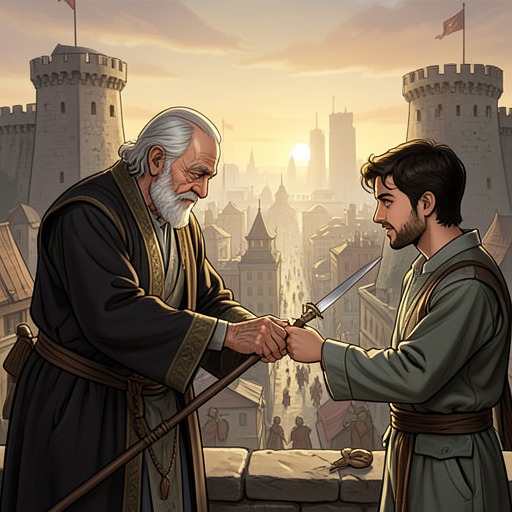
Daedalus
Metamorphoses (Ovid Edition)Daedalus is the great Athenian artificer whose intelligence gives material form to impossible problems. In the surviving episodes, he designs the Labyrinth to conceal the Minotaur, then applies the same inventive power to escape the dominion that has confined him. His decisive significance lies in this double edge of craft: the mind that can build an inescapable enclosure can also imitate Nature closely enough to open a path through the air.
Identity and Introduction
Daedalus is introduced as a master of design, credited with making the draught and forming the “wondrous plan” of the Labyrinth. The structure is not merely a building but a calculated spatial trap: its rooms lie “within themselves encircled,” so that enclosure becomes the governing principle of its form. His reputation therefore rests on an intelligence capable of converting geometry into secrecy and disorientation.
His association with Athens is explicit. He is called “Great Daedalus of Athens,” a title that joins civic identity to exceptional skill. Yet the grandeur of that title is set against his later condition as an exile. The narrative presents him as both celebrated maker and vulnerable subject of political power, showing that technical excellence does not place its possessor beyond punishment or domination.
The Labyrinth and the Problem of Confinement
Daedalus’s most consequential commission is the creation of the Labyrinth. He makes it as a dark enclosure in which the “two-form’d creature” can be hidden far from sight. The design thus answers a political and monstrous problem at once: the creature must be concealed, and the place of concealment must prevent escape. Daedalus’s architecture transforms secrecy into a physical environment.
The Labyrinth also exposes the moral ambiguity of his ingenuity. Its complexity is admirable as workmanship, but its purpose is confinement. The rooms that encircle one another make the builder’s intelligence serve a system of concealment and control. Daedalus does not simply construct a marvel; he constructs a world in which ordinary direction, access, and release have been defeated.
Exile Under Minos and the Invention of Flight
After too long a detention in exile, Daedalus languishes for his native land. His longing is framed through the contrast between land and air: the earth is controlled by Minos, but the air appears free. Against that dominion he resolves that escape must be sought in a new element, declaring that they will go through the air because “the air is free.” The movement from labyrinthine enclosure to open sky reverses the spatial logic of his earlier creation.
To accomplish this escape, Daedalus applies his “cunning thought” to new arts and attempts “to improve the work of Nature.” His method is neither brute force nor direct confrontation with Minos. Instead, he studies natural form and reproduces its principle through artifice. The narrative therefore makes invention a form of adaptation: Daedalus survives by joining human craft to the model supplied by the natural world.
The escape plan begins with a row of quills placed in gradual order. This precise arrangement shows that his freedom depends on disciplined construction rather than sudden inspiration. Feathers are organized, selected, and made into an instrument of passage. The same mind that once arranged rooms into a maze now arranges quills into wings, replacing recursive enclosure with directional ascent.
Change and Narrative Significance
Daedalus’s trajectory is a passage from maker of imprisonment to maker of release. In the Labyrinth, design turns inward, hiding the monstrous form and frustrating movement. In flight, design turns outward, seeking the open air and restoring a route toward the homeland he has lost. The contrast gives his story its central shape: architecture produces the condition of exile, while invention becomes the means of overcoming it.
His transformation is technological rather than bodily. Unlike many figures in the surrounding myths, Daedalus does not become an animal, plant, or god. He changes his circumstances by changing the possibilities of movement. The narrative treats intelligence itself as a transformative power, though not as an unlimited one: his freedom remains dependent on the materials, structures, and natural forms he can master.
Daedalus consequently stands at the boundary between Nature and culture. He does not merely imitate Nature; he tries to improve its work, making feathers and quills serve a human purpose that ordinary wings do not. That ambition is both his resource and his danger, because the elevation from ground to air makes escape possible while exposing the maker to the risks inherent in surpassing ordinary human limits.
Thematic Role
The Daedalus episodes organize a recurring opposition between enclosure and freedom, exile and homeland, concealment and revelation. The Labyrinth hides a creature from sight, whereas flight carries its maker into a space where confinement loses its authority. These reversals make Daedalus a figure of creative intelligence under pressure: invention is not an ornament added to the story but the instrument through which a constrained life becomes mobile again.
His story also complicates admiration for cleverness. Daedalus’s skill can serve concealment, political power, and imprisonment, yet it can later be redirected toward survival. The narrative does not present craft as inherently liberating or destructive. Its effect depends on the end toward which the maker turns it. Daedalus is therefore memorable not simply because he builds marvels, but because the same capacity for intricate construction can produce a prison or a passage to freedom.